





































































































































10 Severe Depression Warning Signs
Author: RVLNSV PRASAD
Updated On: September 2026
About Us
Author Bio
Editorial Policy
Contact Us
Introduction
Depression is more than having a bad day or feeling sad after a difficult event. It is a mental health condition that can affect mood, sleep, energy, concentration, relationships, work, physical health, and the ability to manage everyday responsibilities. The World Health Organization describes depression as a common disorder involving persistent depressed mood or loss of interest or pleasure, with symptoms that can affect daily functioning. World Health Organization: Depressive Disorder (Depression)
The severe depression warning signs can sometimes be difficult to recognize because they do not look exactly the same in everyone. One person may become withdrawn and exhausted, while another may appear irritable, restless, or unusually angry. Some people continue working and communicating with others while privately struggling with severe symptoms.
This is one reason depression should not be judged only by appearance.
The National Institute of Mental Health (NIMH) lists persistent sadness, loss of interest, fatigue, concentration difficulties, sleep changes, appetite or weight changes, feelings of worthlessness, withdrawal, and thoughts of death or suicide among important depression symptoms. National Institute of Mental Health: Depression
This article explains 10 severe depression warning signs, how they can appear in everyday life, when professional help is appropriate, what treatments are available, common mistakes to avoid, and practical ways families and friends can offer support.
Important: This article cannot diagnose depression. Severe or persistent symptoms should be evaluated by a qualified healthcare professional.
Quick Answer
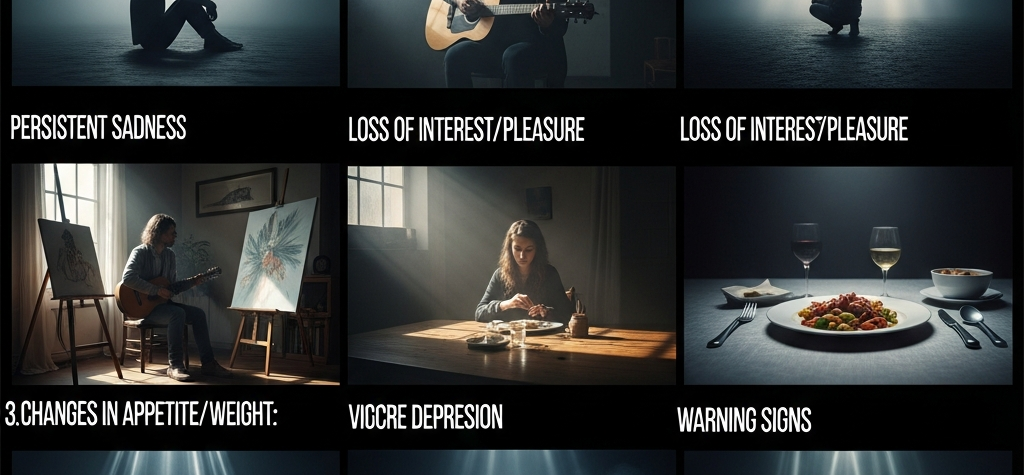
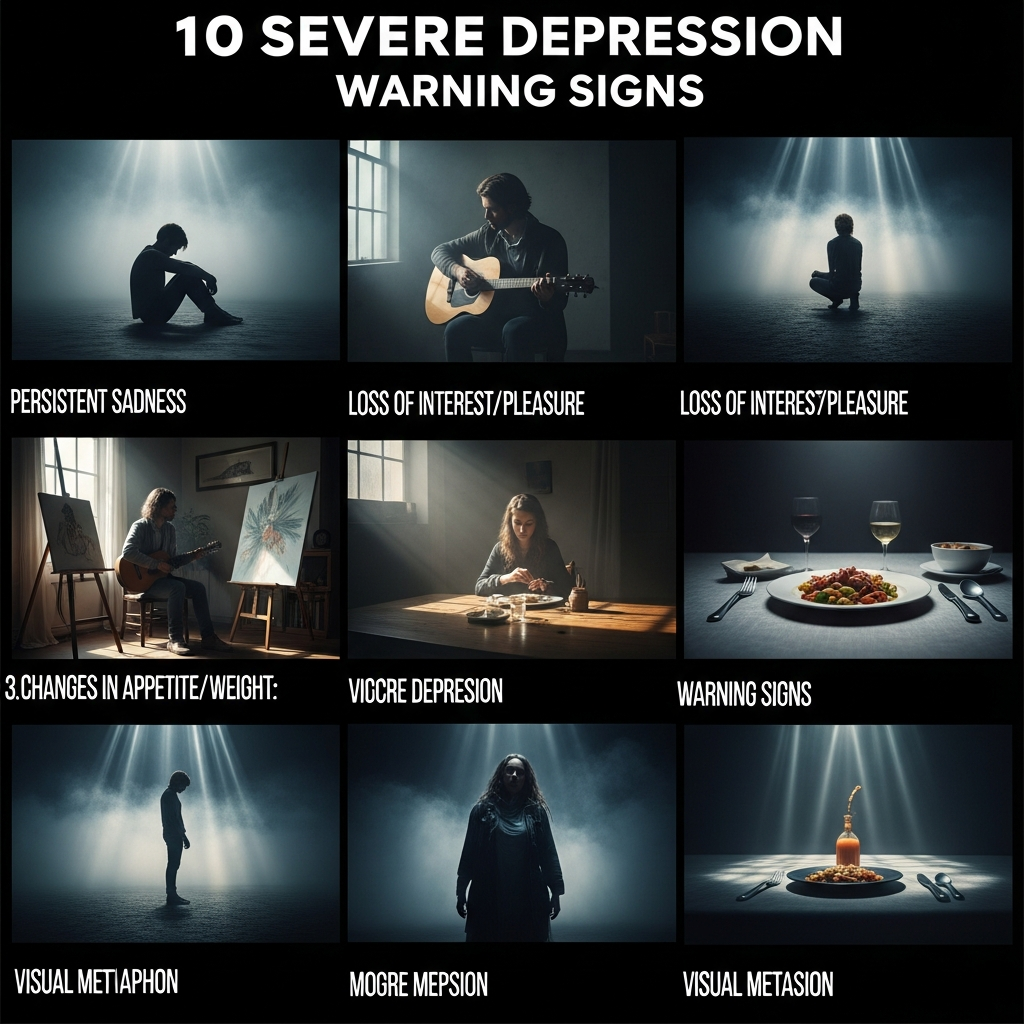
The 10 severe depression warning signs discussed in this article are
- Persistent sadness, emptiness, or hopelessness
- Loss of interest or pleasure
- Severe fatigue or lack of energy
- Major sleep changes
- Significant appetite or weight changes
- Difficulty concentrating or making decisions
- Feelings of worthlessness, guilt, or being a burden
- Social withdrawal and reduced functioning
- Irritability, agitation, or unusual anger
- Thoughts of death, self-harm, or suicide
Not everyone will experience all of these symptoms. Depression can vary considerably from person to person. NIMH also notes that depression may include physical symptoms such as unexplained aches, digestive problems, and headaches, as well as behavioral changes such as increased substance use, isolation, impulsivity, or difficulty meeting responsibilities. NIMH: Signs and Symptoms of Depression
If someone is experiencing thoughts of suicide or feels unable to stay safe, the situation requires immediate professional help, not simply lifestyle advice.
Key Takeaways
- Severe depression is a medical condition, not simply ordinary sadness.
- Symptoms can affect emotions, thinking, physical health, relationships, and daily functioning.
- Persistent low mood or loss of interest is particularly important.
- Sleep, appetite, weight, energy, and concentration can change.
- Depression can sometimes appear as irritability rather than obvious sadness.
- Social withdrawal can be an important behavioral warning sign.
- Thoughts of death, self-harm, or suicide require urgent attention.
- Symptoms lasting around two weeks or longer deserve professional assessment, especially when they interfere with daily life.
- Depression is treatable, including through psychological therapies and, when appropriate, medication.
- Exercise, sleep routines, social connection, and other healthy habits can support recovery but should not replace appropriate treatment for severe depression.
- A friend or family member does not need to diagnose depression to offer support.
- Asking directly about suicide does not replace professional assessment; concerning signs should be taken seriously.
What Is Severe Depression?
Depression is different from the normal emotional ups and downs that everyone experiences.
A person may feel sad after losing a job, ending a relationship, experiencing bereavement, or facing financial difficulties. These reactions can be understandable responses to difficult circumstances.
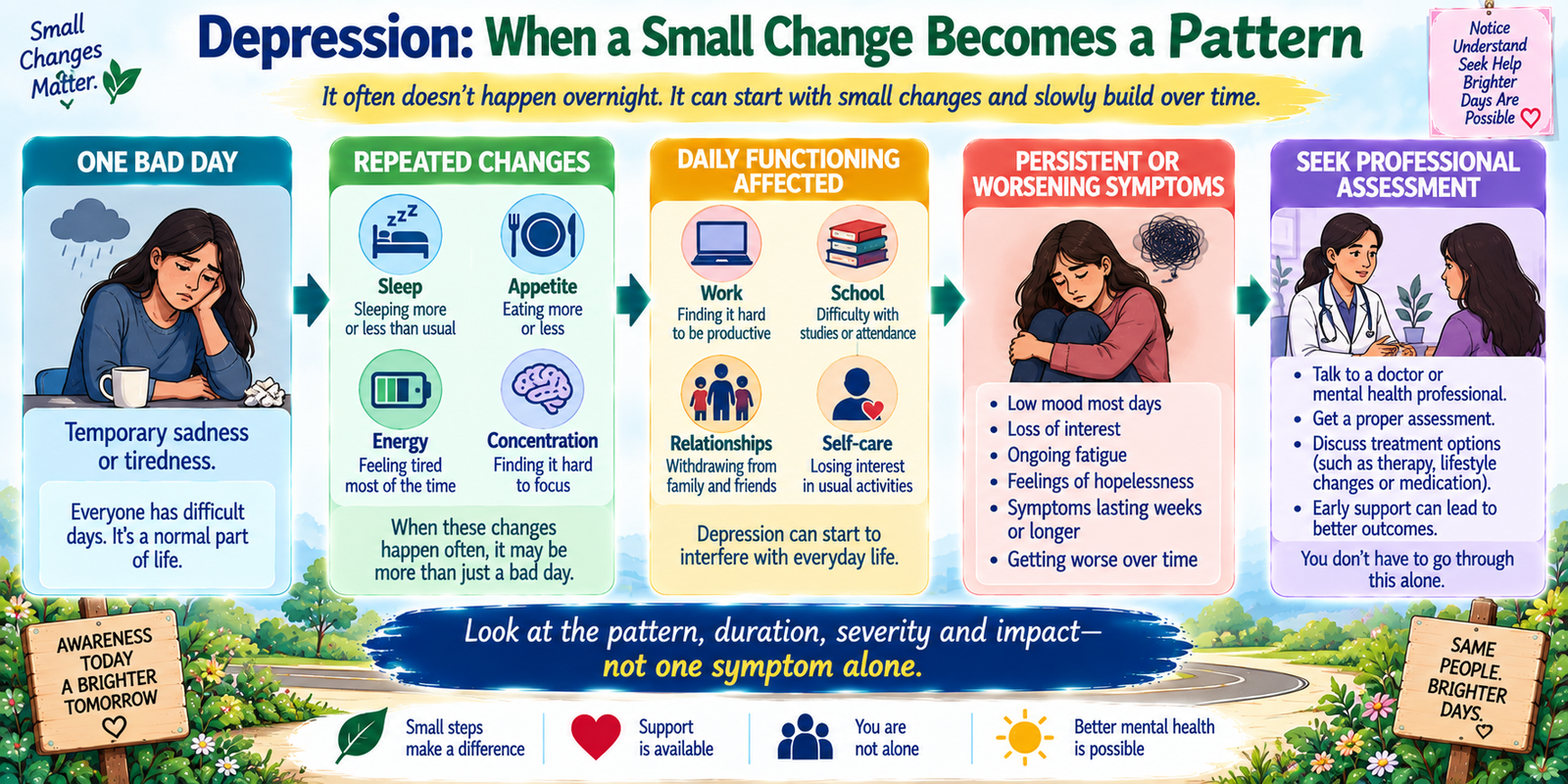
Depression becomes more concerning when symptoms are persistent, cause significant distress, or interfere with everyday functioning.
The WHO states that a depressive episode generally involves symptoms occurring most of the day, nearly every day, for at least two weeks. Symptoms can include depressed mood or loss of interest along with problems such as poor concentration, low self-worth, hopelessness, disrupted sleep, appetite or weight changes, low energy, and thoughts of death or suicide. WHO: Depression Symptoms and Treatment
Severity is not determined by one symptom alone.
Healthcare professionals consider factors such as the number and intensity of symptoms, how long they have been present, how much they interfere with daily functioning, and whether there are safety concerns.
1. Persistent Sadness, Emptiness, or Hopelessness
One of the most recognizable severe depression warning signs is a persistent low mood.
This can feel different from ordinary sadness.
A person may describe feeling:
- Empty
- Deeply sad
- Hopeless
- Emotionally numb
- Tearful
- Pessimistic about the future
- Unable to imagine things improving
Some people may not describe themselves as sad at all. Instead, they may say they feel “nothing,” “drained,” or disconnected from everything around them.
The NHS lists continuous low mood, hopelessness, helplessness, low self-esteem, tearfulness, and guilt among psychological symptoms associated with depression. NHS: Symptoms of Depression in Adults
People-first insight
Do not assume someone is fine simply because they are still going to work, attending college, caring for children, or talking normally.
Some people maintain their responsibilities while experiencing significant emotional distress.
The more useful question is not
“Do they look depressed?”
It is:
“Has their mood, behavior, functioning, or ability to enjoy life changed significantly?”
2. Loss of Interest or Pleasure
Another major sign is losing interest in activities that previously felt enjoyable or meaningful.
This is sometimes described as anhedonia, meaning reduced ability to experience pleasure.
A person may stop:
- Meeting friends
- Playing sports
- Watching favorite programs
- Cooking
- Going outside
- Participating in hobbies
- Attending social events
- Enjoying activities that once mattered
The change may be gradual.
Someone might first skip one activity and then slowly withdraw from several areas of life.
NIMH identifies loss of interest or pleasure in hobbies and activities as a core symptom of depression. NIMH: Depression
A useful observation
Do not confuse temporary boredom with persistent loss of pleasure.
The concern increases when the change continues and begins interfering with relationships, work, education, self-care, or other important areas of life.
3. Severe Fatigue or Lack of Energy
Depression can affect physical energy as well as mood.
A person may feel exhausted even after sleeping.
Ordinary tasks may suddenly require considerable effort.
Getting dressed, preparing food, answering messages, attending work, or taking a shower can feel overwhelming.
NIMH lists fatigue, lack of energy, and feeling slowed down among depression symptoms. NIMH: Depression Symptoms
This symptom is sometimes misunderstood as laziness.
That interpretation can be harmful.
Severe fatigue can be part of depression, but it can also occur with many physical conditions, medication effects, sleep disorders, anemia, thyroid problems, infections, and other causes.
That is why persistent unexplained fatigue deserves proper medical evaluation rather than self-diagnosis.
People-first strategy
Instead of telling someone:
“You just need to be more active.”
try:
“You seem exhausted lately. Is there anything I can do to make today easier?”
Small practical support can be more useful than criticism.
4. Major Changes in Sleep
Sleep changes are another important warning sign.
Depression can be associated with:
- Difficulty falling asleep
- Waking repeatedly
- Waking unusually early
- Sleeping much longer than usual
- Feeling unrefreshed after sleep
- Irregular sleeping patterns
The NHS lists disturbed sleep among physical symptoms of depression, while NIMH notes both insomnia and oversleeping. NHS: Depression Symptoms
A sudden change in sleep should not automatically be labeled depression.
Sleep problems can also occur with anxiety, shift work, sleep apnea, medications, substance use, chronic pain, and other health conditions.
A simple sleep observation
If someone normally sleeps seven hours but has started sleeping 11 or 12 hours and still feels exhausted, or suddenly sleeps only a few hours for many nights, that change deserves attention.
The important point is change from the person’s usual pattern.
5. Significant Appetite or Weight Changes
Depression can affect appetite in different ways.
Some people lose interest in food.
Others eat considerably more, particularly highly palatable foods.
These changes can lead to unplanned weight loss or weight gain.
NIMH lists appetite changes and unplanned weight changes among depression symptoms. NIMH: Depression
A sudden change in eating behavior can therefore be a useful clue, especially when it occurs alongside mood, sleep, energy, or concentration changes.
However, unexplained weight change should not automatically be blamed on depression.
Digestive disorders, thyroid disease, medication effects, infections, diabetes, eating disorders, and other medical conditions can also affect appetite and weight.
Common mistake
One common mistake is assuming that a person who eats more is simply lacking discipline.
Changes in eating can sometimes be part of emotional distress.
Compassion is more helpful than criticism.
6. Difficulty Concentrating or Making Decisions
Depression can affect cognitive functioning.
A person may find it difficult to:
- Read for long periods
- Follow conversations
- Complete paperwork
- Remember details
- Make simple decisions
- Organize tasks
- Focus at work or school
NIMH specifically includes difficulty concentrating, remembering, or making decisions among depression symptoms. NIMH: Depression Symptoms
This can be frustrating because the person may understand what needs to be done but feel unable to organize their thoughts well enough to do it.
Practical example
A person who normally manages several household tasks may suddenly struggle to decide what to cook, answer emails, pay bills, or complete routine paperwork.
That does not necessarily mean they have become careless.
Cognitive symptoms can be part of depression.
7. Feelings of Worthlessness, Excessive Guilt, or Being a Burden
Depression can change how a person interprets themselves and their relationships.
They may think:
- “I am useless.”
- “I always disappoint people.”
- “Everyone would be better without me.”
- “Everything is my fault.”
- “I cannot do anything right.”
These thoughts can feel completely true to the person experiencing them.
That does not mean they accurately describe reality.
WHO includes excessive guilt, low self-worth, and hopelessness among symptoms that can occur during depressive episodes. WHO: Depressive Disorder
Important distinction
You should not argue aggressively with someone who is expressing these feelings.
Instead of:
“That is ridiculous. You have nothing to feel guilty about.”
try:
“I can hear how strongly you are feeling this. You do not have to handle it alone.”
That response acknowledges the person’s distress without confirming the negative belief.
8. Social Withdrawal and Declining Daily Function
Withdrawal can be subtle at first.
Someone may stop replying to messages.
Then they may stop attending social events.
Later, they may avoid family members, colleagues, or activities outside the home.
Depression can also interfere with everyday responsibilities.
NIMH notes that depression can involve isolation from family and friends and difficulty meeting responsibilities or other important roles. NIMH: Depression
This makes social withdrawal particularly important when it represents a clear change from someone’s usual behavior.
A people-first approach
Do not pressure someone into a crowded social event if they are struggling.
A better first step may be
- Sitting together quietly
- Taking a short walk
- Sharing a meal
- Making a phone call
- Helping with a simple task
- Offering to accompany them to an appointment
Support does not always have to look like a major intervention.
9. Irritability, Agitation, or Unusual Anger
Depression is often associated with sadness, but not everyone presents that way.
Some people become unusually irritable, frustrated, restless, or angry.
NIMH includes increased anger or irritability, restlessness, and feeling on edge among behavioral or mood changes that can occur with depression. NIMH: Depression Symptoms
A person may:
- React strongly to minor problems
- Become impatient
- Argue more frequently
- Feel constantly frustrated
- Have difficulty relaxing
- Appear unusually agitated
This does not mean every angry person has depression.
The important clue is a persistent and unusual change, particularly when it occurs alongside other symptoms.
10. Thoughts of Death, Self-Harm, or Suicide
This is the most urgent of the severe depression warning signs.
A person may talk about:
- Wanting to die
- Feeling there is no reason to live
- Feeling trapped
- Believing others would be better without them
- Wanting their emotional pain to stop
- Thinking about suicide
- Thinking about self-harm
NIMH lists thoughts of death or suicide among depression symptoms and separately identifies warning signs such as talking about wanting to die, feeling like a burden, withdrawing, saying goodbye, giving away important possessions, or making a suicide plan. NIMH: Warning Signs of Suicide
What to do if someone may be in immediate danger
Take the situation seriously.
Stay with the person if it is safe to do so, help them connect with immediate professional support, and reduce access to obvious means of harm when you can do so safely.
If the person is in immediate danger, contact local emergency services or go to the nearest emergency department.
For readers in India, the Government of India’s Tele-MANAS service provides 24/7 tele-mental-health support through 14416 or 1-800-891-4416. Government of India: National Mental Health Programme and Tele-MANAS
If you are outside India, use your country’s emergency service or crisis service.
Do not rely on a blog article during an emergency.
An online article cannot assess immediate suicide risk.
If someone is in immediate danger, professional emergency assistance takes priority over reading more information online.
How Severe Depression Can Look Different From Person to Person
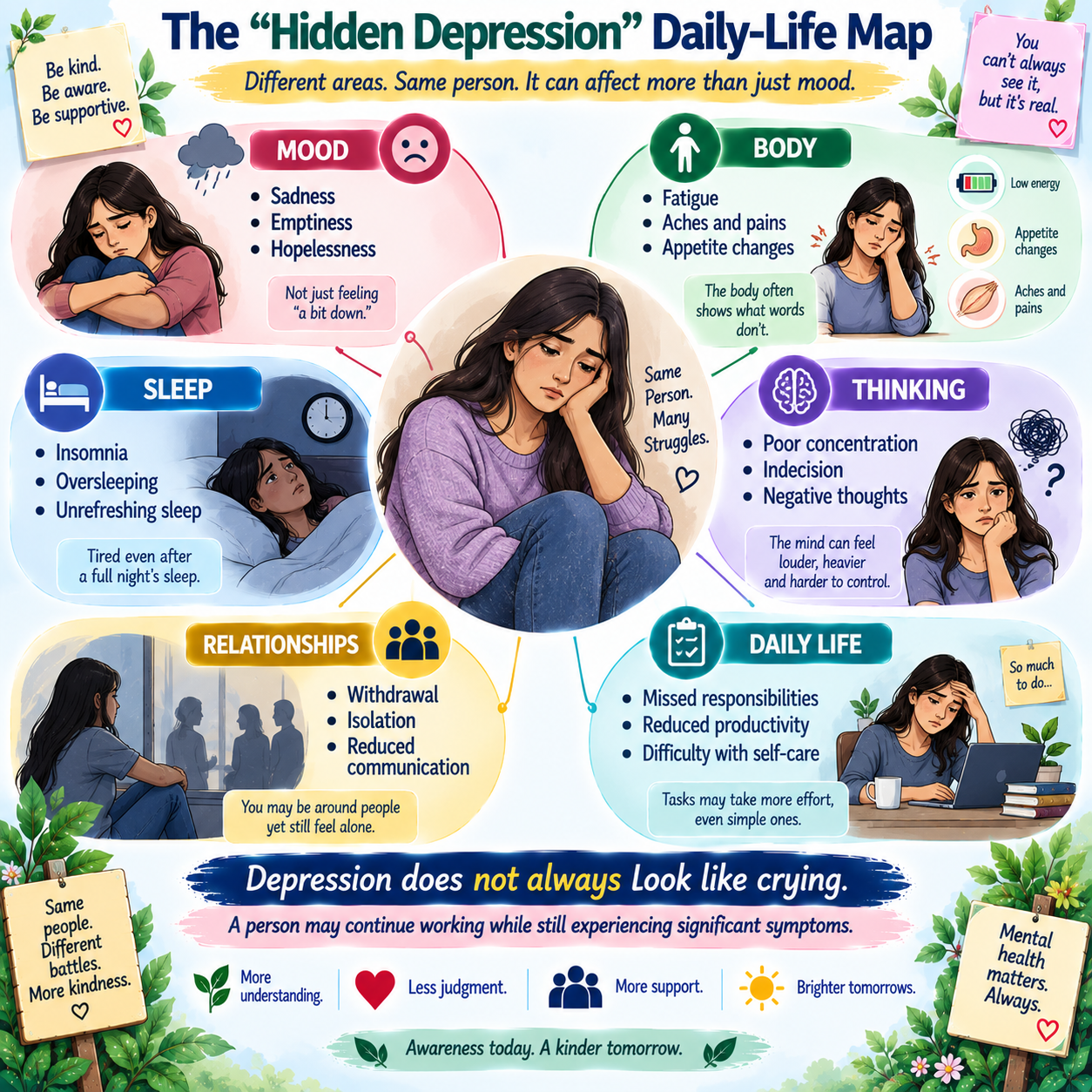
There is no single appearance of severe depression.
| Person’s experience | Possible changes |
|---|---|
| Emotional | Sadness, emptiness, hopelessness |
| Behavioral | Withdrawal, reduced activity, neglecting responsibilities |
| Physical | Fatigue, sleep changes, appetite, or weight changes |
| Cognitive | Poor concentration, indecision, negative thinking |
| Social | Avoiding friends and family |
| Emotional expression | Irritability, anger, restlessness |
| Safety | Thoughts of death, self-harm, or suicide |
NIMH emphasizes that not everyone with depression experiences every symptom, and symptoms can vary in severity and frequency. NIMH: Depression
This is why a checklist should be used for awareness rather than self-diagnosis.
When Should You Seek Professional Help?
Consider professional evaluation when symptoms:
- Persist for around two weeks or longer
- Become increasingly severe
- Interfere with work or education
- Affect relationships
- Make normal responsibilities difficult
- Cause significant changes in sleep or appetite
- Cause persistent hopelessness
- Lead to thoughts of death or self-harm
NIMH advises seeking professional help when severe or distressing symptoms last two weeks or more, including difficulty sleeping, appetite or weight changes, difficulty getting out of bed, concentration problems, loss of interest, inability to complete usual tasks, and irritability or restlessness. NIMH: Caring for Your Mental Health
You do not have to wait until symptoms become unbearable.
Early professional assessment can help determine whether the symptoms are caused by depression, another mental health condition, a physical illness, medication, substance use, or a combination of factors.
How Is Depression Diagnosed?
There is no single blood test that proves someone has depression.
A healthcare professional usually considers:
- Symptoms
- Duration
- Severity
- Daily functioning
- Medical history
- Medications
- Substance use
- Other mental health symptoms
- Relevant physical health conditions
NIMH notes that some medical conditions and medications can cause symptoms that resemble depression, including thyroid disorders and certain other health problems. A healthcare professional may therefore use an interview, examination, and sometimes laboratory tests to rule out other causes. NIMH: Depression Diagnosis
This is another reason self-diagnosis based on an internet checklist is not enough.
Evidence-Based Treatment for Severe Depression
The good news is that depression is treatable.
WHO states that effective treatments are available for mild, moderate, and severe depression. Psychological treatments include approaches such as cognitive behavioral therapy, behavioral activation, interpersonal psychotherapy, and problem-solving therapy. WHO: Depressive Disorder Treatment
Treatment can include:
Psychological therapy
Psychological therapies can help people understand patterns of thinking, behavior, relationships, and coping.
Examples include:
- Cognitive behavioral therapy
- Behavioral activation
- Interpersonal psychotherapy
- Problem-solving therapy
The appropriate approach depends on the person’s symptoms, preferences, availability, and clinical needs.
Medication
Antidepressants may be appropriate for some people, particularly when depression is moderate or severe.
Medication should be prescribed and monitored by a qualified healthcare professional.
NICE recommends matching treatment to the person’s clinical needs and preferences and monitoring response, side effects, and suicidal thoughts during treatment. NICE: Depression in Adults — Treatment and Management
Treatment for severe or treatment-resistant depression
More severe depression may require specialist mental health care.
NICE’s January 2026 surveillance review notes that standard treatment can include antidepressants, psychological therapies, or a combination, and that electroconvulsive therapy may be considered for severe depression in specific circumstances, such as when a rapid response is needed or other treatments have failed. NICE: January 2026 Surveillance of Depression Guideline
This does not mean ECT is appropriate for everyone with severe depression. Treatment decisions should be individualized by a qualified clinical team.
Latest Research Developments in Depression Care
Depression research continues to move beyond the idea that depression has one simple cause.
Current evidence supports a more complex understanding involving biological, psychological, social, environmental, and behavioral factors.
WHO describes depression as resulting from a complex interaction of social, psychological, and biological factors. WHO: Depression and Contributing Factors
1. Digital and guided psychological support is expanding.
WHO published updated material in 2026 describing Step-by-Step, an evidence-based psychological self-help intervention designed to support people experiencing depression through digital or other accessible formats. The program has shown effectiveness in multiple randomized controlled trials when combined with brief weekly support from a trained non-specialist helper, highlighting how structured psychological support may be delivered in settings where access to traditional mental-health services is limited. WHO: Step-by-Step Psychological Self-Help Intervention
This is particularly interesting for people who have difficulty accessing traditional mental health services.
However, digital self-help should not be treated as a substitute for urgent clinical care when symptoms are severe or there is an immediate safety risk.
2. Treatment is becoming more personalized.
Current guidance increasingly emphasizes matching treatment to the individual’s symptoms, preferences, previous treatment response, side-effect concerns, and clinical circumstances.
NICE recommends shared decision-making when selecting treatment and emphasizes monitoring response and adverse effects. NICE: Depression Treatment Recommendations
This means there is no single “best depression treatment” for every person.
3. Relapse prevention is receiving more attention.
Recovery is not simply about making symptoms disappear.
People who have experienced depression may benefit from identifying early warning signs that preceded previous episodes.
NICE recommends discussing relapse prevention and identifying warning signs such as worsening anxiety, poor sleep, avoidance, or rumination in people at risk of relapse. NICE: Relapse Prevention in Depression
A practical idea is to create a personal early-warning list with a healthcare professional.
For example:
My early changes:
- Sleeping less
- Stopping exercise
- Avoiding friends
- Missing work
- Losing interest in hobbies
- Increasing alcohol use
Recognizing these patterns early can make it easier to seek help promptly.
Simple People-First Strategies That Can Support Recovery
These strategies are not cures for severe depression.
They are supportive habits that can complement professional care.
Keep one daily anchor.
Choose one predictable activity, such as
- Getting up at a consistent time
- Eating breakfast
- Taking a short walk
- Showering
- Calling someone
- Going outside for a few minutes
The goal is not to complete a perfect routine.
It is to create one reliable point in the day.
Use the “smallest useful step.”
When motivation is extremely low, large goals can feel impossible.
Instead of:
“I need to exercise for one hour.”
try:
“I will walk for five minutes.”
Instead of:
“I need to clean the whole house.”
try:
“I will clear one small surface.”
This approach is consistent with the broader principle of behavioral activation, which WHO identifies as an effective psychological treatment for depression. WHO: Depression Treatment
Make reaching out easier.
Instead of waiting until you feel ready to explain everything, send a simple message:
“I have not been feeling like myself lately. Could we talk?”
A person does not need to provide a perfect explanation before asking for support.
Protect basic routines.
Try to maintain regular:
- Meals
- Sleep
- Medication, if prescribed
- Medical appointments
- Social contact
- Gentle physical activity when appropriate
NIMH recommends maintaining healthy sleep, nutrition, physical activity, and social connection as part of mental health self-care. NIMH: Caring for Your Mental Health
A Simple “Three-Person Support” Idea
One practical approach that can make support easier is to identify three people:
1st Person: Emotional support
Someone you can talk to honestly.
2nd Person: Practical support
Someone who can help with appointments, food, transportation, or daily tasks.
3rd Person: Professional support
A doctor, psychologist, psychiatrist, counselor, or another qualified healthcare professional.
This is not a medical treatment model.
It is simply a practical way to avoid depending on one person for every type of support.
Common Mistakes About Severe Depression
Mistake 1: “Just think positively.”
Positive thinking alone does not treat severe depression.
Depression can involve biological, psychological, and social factors, and evidence-based treatment may be needed. WHO: Depression
Mistake 2: Assuming depression always looks like sadness
Irritability, withdrawal, exhaustion, sleep changes, concentration problems, and loss of interest can also occur.
Mistake 3: Telling someone to simply exercise more
Physical activity can support mental health, but severe depression may require professional treatment.
WHO includes regular exercise as a useful self-care measure while also recommending professional care for depression. WHO: Depression Self-Care and Treatment
Mistake 4: Stopping medication suddenly
Antidepressants should not be started, stopped, or changed without medical guidance.
NICE specifically recommends discussing medication changes with healthcare professionals because stopping or changing treatment can involve withdrawal effects and other considerations. NICE: Antidepressant Treatment and Management
Mistake 5: Assuming talking about suicide makes things worse
If someone is showing suicide warning signs, avoiding the subject because it feels uncomfortable is not a useful safety strategy.
Take statements about wanting to die, being a burden, feeling trapped, or having no reason to live seriously. NIMH identifies these among warning signs that require prompt attention. NIMH: Warning Signs of Suicide
Mistake 6: Trying supplements instead of getting care
Supplements are not a replacement for evidence-based depression treatment.
Some supplements can also interact with prescription medicines.
Discuss supplements with a qualified healthcare professional before using them to manage depression.
How Family and Friends Can Help
You do not need to diagnose someone to support them.
Try:
- Listening without immediately giving advice
- Asking how they have been feeling
- Offering practical help
- Encouraging professional care
- Checking in again later
- Taking suicide warning signs seriously
- Avoiding judgmental comments
- Respecting their dignity
Instead of:
“You have everything you need. Why are you depressed?”
try:
“I can see that you are struggling. I am here with you, and we can find help.”
Small changes in communication can make conversations safer and more supportive.
What Not to Say to Someone With Depression
Avoid statements such as
- “Everyone feels sad sometimes.”
- “You just need to be stronger.”
- “Stop thinking negatively.”
- “Other people have bigger problems.”
- “You have nothing to be depressed about.”
- “Exercise and you will be fine.”
- “You should be able to fix this yourself.”
These statements may unintentionally increase shame.
A better approach is to acknowledge the person’s experience and encourage appropriate professional support.
Depression and Physical Activity
Physical activity can be useful as part of a broader mental health plan.
It should not be presented as a replacement for treatment in severe depression.
WHO includes regular exercise, even a short walk, among self-care strategies that may support people experiencing depression. WHO: Depression Self-Care
If someone is severely depressed, start with realistic expectations.
A five-minute walk may be more achievable than an ambitious workout plan.
If exercise causes significant physical symptoms or the person has another medical condition, they should seek appropriate medical advice.
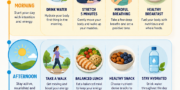
A Simple Daily Support Plan
| Part of day | Simple goal |
|---|---|
| Morning | Get up, wash, and open the curtains. |
| Breakfast | Eat something nourishing if possible. |
| Midday | Complete one necessary task. |
| Afternoon | Short walk or gentle activity if appropriate |
| Evening | Contact one supportive person. |
| Night | Follow a consistent wind-down routine |
| During distress | Contact a trusted person or professional. |
| During immediate danger | Seek emergency help immediately. |
This is not a depression treatment prescription.
It is a simple framework for reducing the pressure to “fix everything” at once.
When Depression Becomes an Emergency
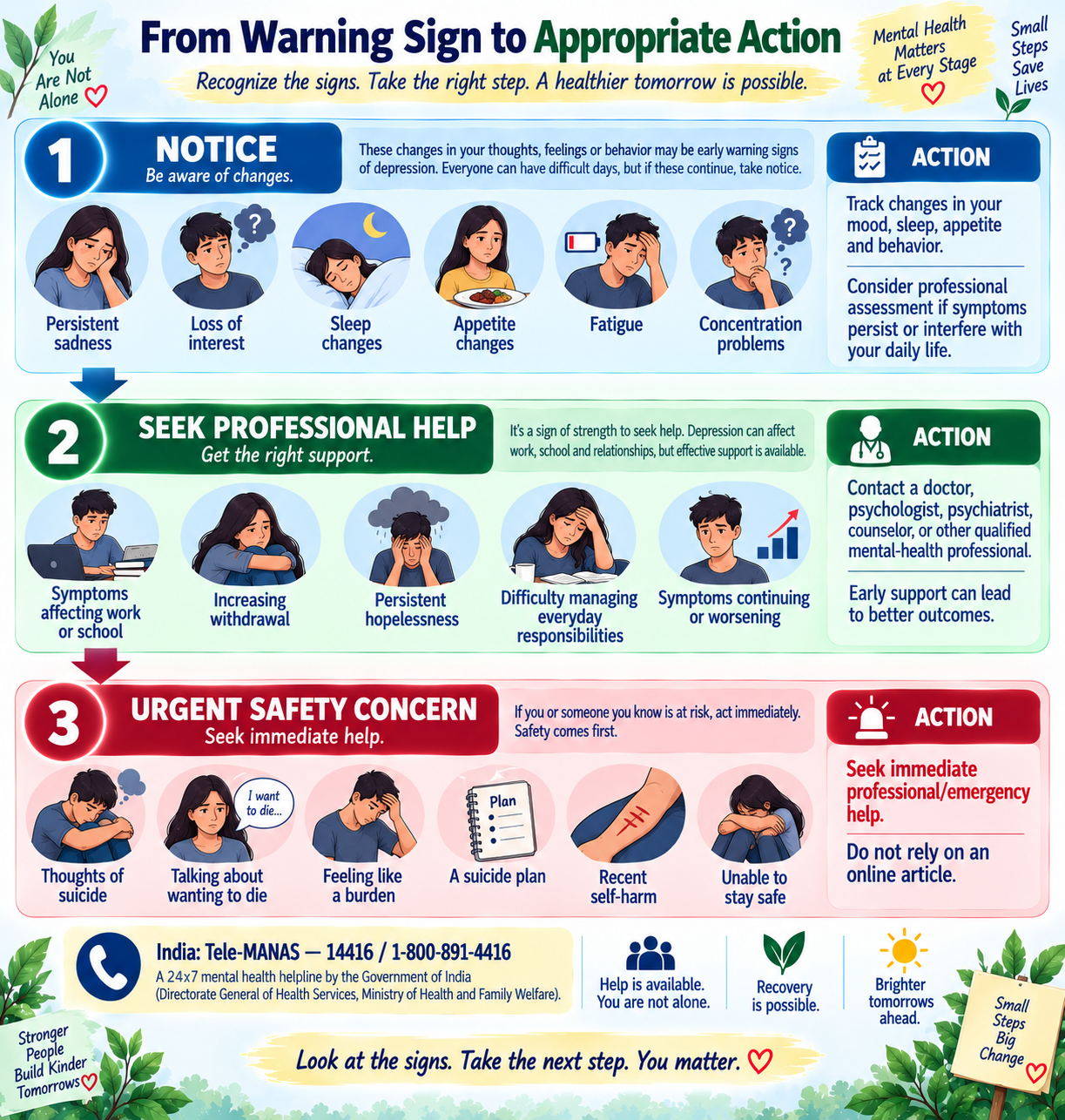
Seek urgent help if a person:
- Says they want to die
- Says others would be better without them
- Has a suicide plan
- Has recently attempted self-harm
- Is unable to remain safe
- Is severely confused or disconnected from reality
- Cannot care for basic needs
- Presents an immediate danger to themselves or someone else
NIMH advises getting help as soon as possible when suicide warning signs are present, particularly when the behavior is new or has increased recently. NIMH: Suicide Warning Signs
For readers in India, Tele-MANAS can be reached at 14416 or 1-800-891-4416 for 24/7 tele-mental-health support. Government of India: Tele-MANAS
If there is immediate physical danger, contact local emergency services or go to the nearest emergency department.
FAQ
What are the severe depression warning signs?
Important signs can include persistent sadness or hopelessness, loss of interest, severe fatigue, sleep changes, appetite or weight changes, concentration problems, worthlessness or excessive guilt, social withdrawal, irritability, and thoughts of death or suicide.
Not everyone experiences all of these symptoms. NIMH: Depression Symptoms
How long do depression symptoms need to last?
A depressive episode generally involves symptoms present for most of the day, nearly every day, for at least two weeks. However, you should not wait for exactly two weeks if symptoms are severe, rapidly worsening, or involve thoughts of suicide or self-harm. WHO: Depressive Disorder
Can severe depression happen without obvious sadness?
Yes.
Some people may show more irritability, withdrawal, fatigue, loss of interest, sleep problems, or difficulty functioning than obvious sadness.
Can depression cause physical symptoms?
Yes.
Depression can be associated with fatigue, sleep changes, appetite or weight changes, and physical aches or digestive problems. However, physical symptoms can have many causes and should not automatically be attributed to depression. NIMH: Depression
Can severe depression be treated?
Yes.
Effective treatments include psychological therapies and, depending on the severity and individual circumstances, medication. Severe depression may require specialist care. WHO: Depression Treatment
Is exercise enough to treat severe depression?
Exercise can support mental health and may be part of a treatment plan, but it should not be used as a substitute for professional care when depression is severe.
Can friends help someone with depression?
Yes.
Listening, maintaining contact, offering practical help, and encouraging professional care can be valuable. If suicide warning signs appear, seek urgent professional assistance rather than trying to manage the situation alone.
What should I do if someone says they want to die?
Take the statement seriously.
Stay with them if it is safe, encourage immediate professional help, and contact emergency services if they are in immediate danger. In India, Tele-MANAS is available at 14416 or 1-800-891-4416. Government of India: Tele-MANAS
Can depression improve without treatment?
Some people with mild symptoms may improve with supportive measures, but persistent, severe, or functionally impairing symptoms should be professionally assessed. WHO confirms that effective treatments are available for depression. WHO: Depression
Is depression simply a chemical imbalance?
No.
Depression is more complex than a simple chemical-imbalance explanation. Current understanding involves interactions among biological, psychological, social, and environmental factors. WHO: Depression and Contributing Factors
Bottom Line
The 10 severe depression warning signs should be understood as important signals rather than a self-diagnosis checklist.
Persistent sadness or hopelessness, loss of interest, severe fatigue, sleep changes, appetite or weight changes, concentration problems, feelings of worthlessness, social withdrawal, irritability, and thoughts of death or suicide can all occur with depression.
The most important issue is not whether someone has exactly ten symptoms.
It is whether their emotional or behavioral changes are persistent, severe, causing distress, interfering with daily life, or creating a safety concern.
Depression is treatable, and asking for help is not a sign of weakness. Psychological therapies, medication when appropriate, social support, healthy routines, and other evidence-based approaches can all have a role in recovery. WHO: Depression Treatment and Self-Care
If you recognize several of these signs in yourself or someone you care about, consider contacting a qualified healthcare professional.
If there are thoughts of suicide, self-harm, or immediate danger, seek urgent help rather than waiting for symptoms to improve on their own.
Author Note
This article was written with a people-first approach. The goal is to explain the warning signs of severe depression in simple language while avoiding the common mistake of treating an online checklist as a diagnosis.
The medical information is based primarily on current guidance and information from the World Health Organization, the National Institute of Mental Health, the NHS, NICE, and the Government of India’s mental health resources.
Personal experiences with depression can differ considerably. A person’s symptoms, medical history, treatment needs, and safety situation should therefore be assessed individually by a qualified healthcare professional.
Author: RVLNSV PRASAD
Medical Disclaimer
This article is for general educational purposes only. It is not a diagnosis, medical opinion, or substitute for professional mental health care.
The symptoms described in this article can occur with depression and other mental or physical health conditions. Only a qualified healthcare professional can assess symptoms and provide an appropriate diagnosis and treatment plan.
Do not stop, start, or change psychiatric medication based only on information in this article.
If you or someone you know is experiencing thoughts of suicide, self-harm, or an immediate safety risk, seek urgent professional or emergency assistance.
Fitness Disclaimer
Physical activity can support mental and physical well-being and may be useful as part of depression care. However, exercise is not a replacement for professional treatment for severe depression.
If you have severe depression, another medical condition, significant physical symptoms, or have been inactive for a long period, discuss an appropriate exercise plan with a qualified healthcare professional.
Strong E-E-A-T Sources
- National Institute of Mental Health — Depression
- National Institute of Mental Health — Warning Signs of Suicide
- National Institute of Mental Health — Caring for Your Mental Health
- World Health Organization — Depressive Disorder (Depression)
- World Health Organization — Depression in India
- NHS — Symptoms of Depression in Adults
- NICE — Depression in Adults: Treatment and Management
- NICE — January 2026 Surveillance of Depression Guideline
- Government of India — National Mental Health Programme and Tele-MANAS
- U.S. Preventive Services Task Force — Depression and Suicide Risk Screening in Adults
Related Topics
- 10 Effective Treatments for Depression Without Medication
- Best Ways to Treat Kidney Stones10 Early Signs Of Heart Failure
- 10 Early Signs Of Heart Failure
- How to Improve Your Mood with Healthy Habits: A Comprehensive Guide
- 10 Causes of Low Blood Pressure
- Home
- Category Mind & Mood Care







[…] 10 Severe Depression Warning Signs […]